Projects
Retweets and Ideal Points: Political Ideology on Twitter/X
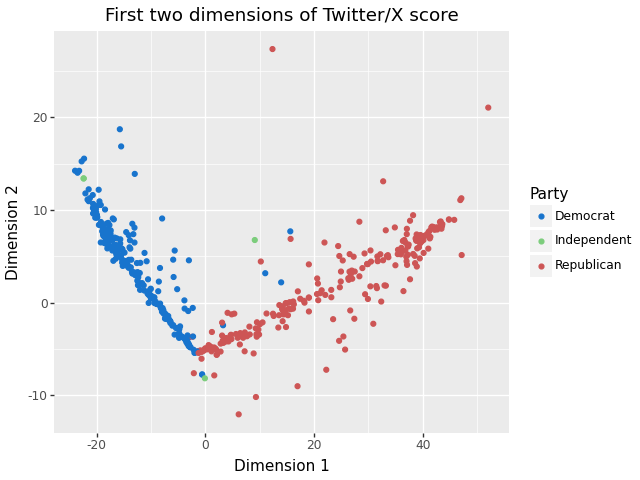
For my senior Honors thesis, I developed a quantitative measure of political ideology using social media as a source of data. I applied dimensionality reduction to a matrix of retweets from users on Twitter/X to members of Congress, generating numbers for the location of each politician on a two-dimensional ideological spectrum. I found that my score strongly correlated with the existing, established measures of political ideology, such as DW-NOMINATE, suggesting that it is an effective alternative. However, as my score is based on social media, a more flexible source of data than those used by the existing measures, my score has utility in situations where the existing measures cannot be applied, such as in local politics or with small campaigns.
Socio-Spatial Disparities in Access to Driver Education for Teens
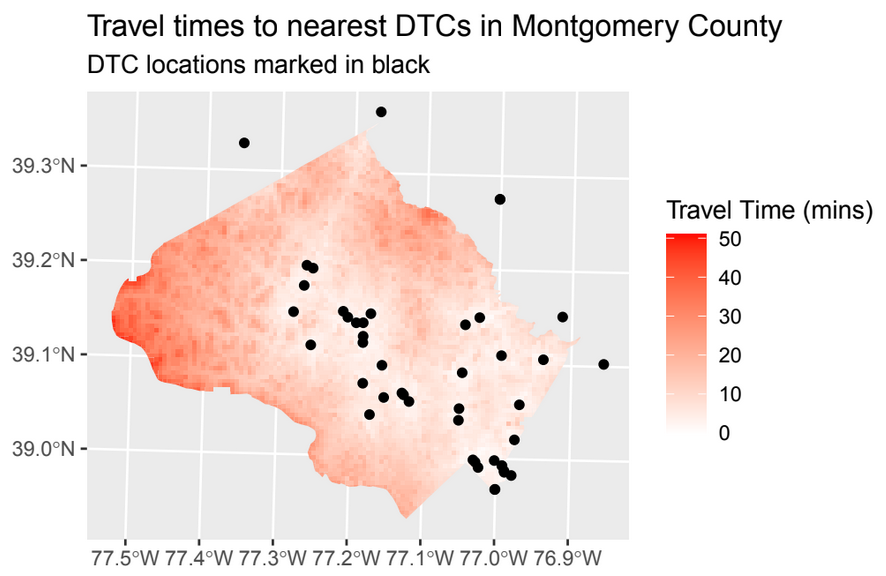
I utilized advanced spatial analysis techniques to measure the relationship between proximity to driver training centers (DTCs), locations where individuals can go to receive their driver's education, and traffic citations. This work developed from past research demonstrating that drivers who recieve their license after age 17, when the requirement to attend driver training is dropped in many states, are actually less safe than younger drivers who attend driver training.
I first applied a routing algorithm, similar to Google Maps, to identify how long it would take for anyone in the study area to driver to the nearest DTC. From there, I used point-pattern anlysis and Ripley's K-function to statistically analyze the spatial relationship between those travel times and the distribution of traffic citations. We found that there was a significant relationship, although the nature of that relationship was less clear. I also assisted in developing the conference presentation for this work.
Davidson, Joshua H., Noah Elazar, Sangeetha Ramanuj, and Megan S. Ryerson. 2025. “Socio-Spatial Disparities in Access to Driver Education for Teens.” In preparation, to be submitted summer 2026. Presented at 2025 American Association of Geographers Annual Meeting. Detroit, MI.
Rust Shocks
As an NSF REU student at Carnegie Mellon University, I measured the impact of a layoff from Mozilla on the ecosystem of open-source developers for the Rust programming language. Mozilla was heavily involved in the development of the language, and continued to support many of the software packages for Rust following the open-sourcing of the language. They laid off a significant percentage of their developers in 2021, leading to concerns about the future of the Rust ecosystem. I downloaded billions of commits from Rust packages, and used qualitative and quantitative means to identify some of the laid off developers in the commit records. I applied regression discontinuity design (RDD) and ended up discovering that not only did the overall ecosystem not face a significant decline in commits, but even the laid off developers continued contributing at a similar rate following the event.

Empirically Measuring the Mobility Outcomes of New Equity-Oriented Transit
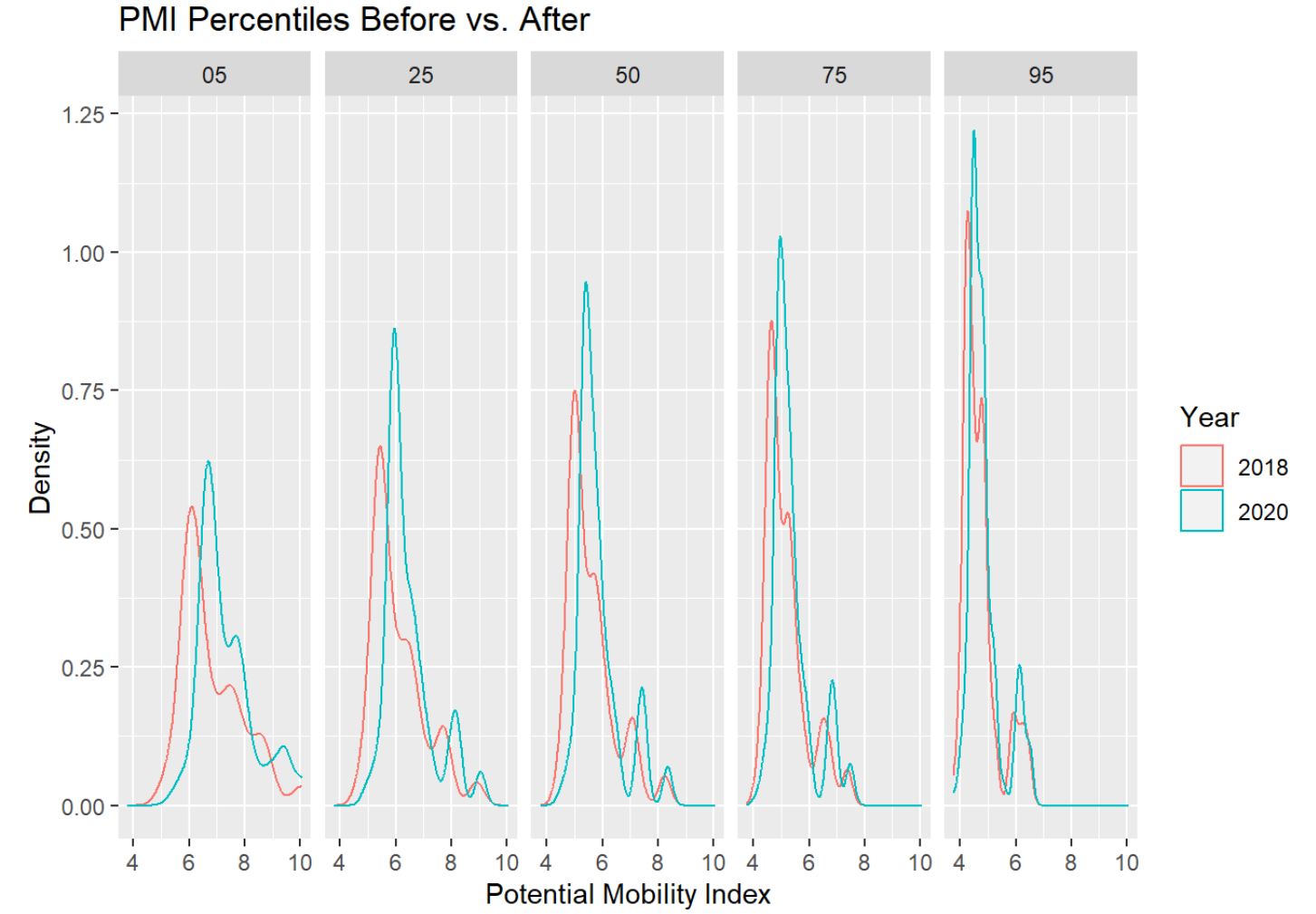
In 2019, Philadelphia's SEPTA transit system introduced a new bus line connecting two low-income neighborhoods previously underserved by transit. We used a sample, based on surveys conducted on SEPTA buses, of commutes between these two neighborhoods to analyze the change to real people's mobility with the introduction of this new line. I pulled bus schedules using the General Transit Feed Specification (GTFS), and mapped out the routes for each individual, as well as the routes between each possible origin and destination pair. From there, I calculated the mobility scores for each person before and after the introduction of the new bus line. We demonstrated a significant improvement in mobility for these neighborhoods overall given this new line.
Davidson, Joshua H., Noah Elazar, Sophia Ungar, and Megan S. Ryerson. 2023. “Empirically Measuring the Mobility Outcomes of New Equity-Oriented Transit.” In preparation, to be submitted January 2026. Presented at 2023 East Lakes Division-American Association of Geographers Annual Meeting. Oregon, OH.
Parsing Congressional Hearing Transcripts
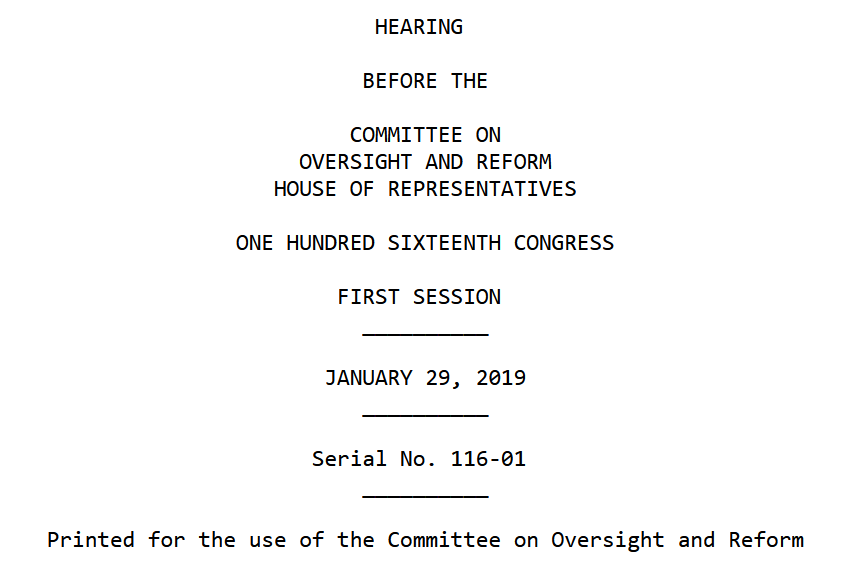
Professor Jenny Garcia at Oberlin College studies the words that members of Congress use in their speeches in hearings. She was looking for a way to speed up the manual process of going through hearing transcripts and labeling each speech with its speaker. I developed a Python script that would read each file and recognize the patterns that indicated the speakers, breaking up the text and storing each speech in a SQLite database. After laying out the intial system to parse transcripts, I went back through and tweaked it to handle the countless typos and slight variations in formatting for each different Congressional committee.
Web Design for Difede Ramsdell Bender PLLC
I was hired to redesign the website of boutique law firm Difede Ramsdell Bender PLLC. I created a new logo and design language, and developed a modern website to reflect the expansion of their firm. I implemented the design using Wix, and set up mechanisms for the firm to easily upload new content such as news articles and new projects.